State-Dependent Relations
“Alongside human-dependent and commodity-dependent relations stands a constitutive third axis of historical reproduction: state-dependent relations.”
Extends Marx’s typology of human-dependent and commodity-dependent social relations by establishing the state as an irreducible variable in social reproduction—overcoming base-superstructure reductionism and situating political power within an infinite matrix of historical variables.
Adjacent Concept Nodes (4)
Class & Individual Freedom
Critiques classical and post-Marxist traditions for reducing the concrete person to an element of a class-set whose freedom is perpetually deferred to a post-revolutionary utopia. Insists on immediate, unmediated individual autonomy alongside social justice.
Aristotle–Hegel–Marx Theory of History
Charts the intellectual lineage connecting Aristotelian value theory and categories, Hegelian Reason in history, and Marxist historical materialism—honoring all three masters while emancipating historical science from teleological closure.
Töre & the Historical Subject
Conceptualizes the nation neither as biological essentialism nor as mere modern discursive invention, but as the historical-political form of shared memory and constitutive reason forged through collective survival—with töre serving as its ontological anchor against global regimes of indeterminization.
No Closed Whole
The foundational proposition of İsmet Şahin’s philosophy. Rejecting the closed-system postulate inherited from Newtonian mechanics by modern social and political theories, it holds that every physical, cognitive, and historical structure remains open to external interaction, contingency, and revision.
Writings Addressing This Concept (10)
Rethinking the Turkish Hearths, Rethinking Turkism
Conceptualizes Turkism neither as biological essentialism nor as romantic nostalgia, but as an ontological, customary (töre), and political principle preserving the historical subject against global regimes of indeterminization. Re-examines the 1912 institutional legacy of the Turkish Hearths, critiques ideological double standards toward Eurasian integration, and frames the multilayered unity of the Turkic world as a question of historical being.
Read Essay →İsmet Şahin: Thought and Philosophy
A comprehensive intellectual monograph tracing İsmet Şahin’s philosophical evolution from classical engagements with Aristotle, Hegel, and Marx to his post-Marxist critique of class reductionism and his formulation of open-ended quantum epistemology built on the proposition that ‘there is no closed whole.’
Read Essay →Hegel and the Concept of History: A Critical Review
An extensive critical treatise examining G. W. F. Hegel’s Die Vernunft in der Geschichte and Science of Logic. Reconstructs Hegel’s overcoming of Kantian-Fichtean dualism, the determinations of Reason, and the realization of Spirit in world history while exposing the limits of closed teleological system-building.
Read Essay →The Rational Revolution and Hegel
A sustained philosophical refutation of Karl Popper’s portrayal of Hegel in The Open Society and Its Enemies. Situates Hegelian dialectics within the emancipatory horizon of the French Revolution and Enlightenment rationality, examining Reason, culture, and the state in historical context.
Read Essay →Escaping Class: A Philosophical Critique of Marxism — An Advanced Scientific Critique
An in-depth scholarly analysis of İsmet Şahin’s Escaping Class (Sınıftan Kaçan Çocuk), dissecting the tension between research and presentation in Marx’s method, the ossification of dialectical materialism, class reductionism, state-dependent social reproduction, and the primacy of individual liberty.
Read Essay →State-Dependent Relations: The State-Dependent Nature of Modern Social Movements
Introduces İsmet Şahin’s signature concept of ‘state-dependent relations’ alongside Marx’s human-dependent and commodity-dependent forms. Reassesses alienation and surplus production, critiques anthropomorphic teleology in classical political economy, and proposes a complex historical science grounded in an infinite matrix of variables.
Read Essay →Anti Kapitalist Manifesto: Dialectics and Revolutionary Praksis
A thematic philosophical examination of İsmet Şahin’s Anti Kapitalist Manifesto, exploring the role of philosophy in transformative praksis, the dual legacy of Hegelian dialectics, critiques of utopian idealism, capitalist crisis tendencies, solidarity across ethnic divisions, and global imperialism.
Read Essay →Philosophical Critique of Sınıftan Kaçan Çocuk
Engages directly with textual passages from Sınıftan Kaçan Çocuk across four axes: Marxism’s deferral of individual freedom, the methodological aporia of dialectical materialism, state-dependent social relations, and the paradoxical emancipatory horizon of globalization.
Read Essay →A Critique of Sınıftan Kaçan Çocuk
Situates Sınıftan Kaçan Çocuk in critical dialogue with Sartre, Gramsci, Foucault, Wallerstein, and Habermas across six philosophical themes: individual versus collective identity, deferred utopianism, state power dynamics, historical complexity, globalization, and concrete human emancipation.
Read Essay →Child Escaping from the Class: Reader’s Companion and Excerpt
Presents the central arguments of Child Escaping from the Class (Sınıftan Kaçan Çocuk) on personal autonomy, state-dependent relations, and the critique of orthodox Marxism, accompanied by a selected translation from the book.
Read Essay →Related Books (3)

Escaping Class (Sınıftan Kaçan Çocuk)
A Philosophical Critique of Marxism, Individual Freedom, and State-Dependent Relations
Individual freedom cannot be mediated through class membership or deferred to a future utopia; opening the concrete spaces of individual autonomy here and now is the precondition—not the postponed byproduct—of social emancipation.

Anti-Capitalist Manifesto
The Dialectics of History, Capitalist Contradictions, and Revolutionary Praksis
Capitalism is not an eternal horizon of human history but a contradictory historical formation; genuine emancipatory praksis demands uniting philosophical reason with a non-utopian critique of political economy and imperial power.
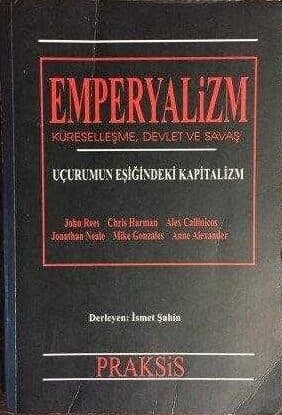
Imperialism (Emperyalizm)
Globalization, State, and War — Capitalism on the Brink of the Abyss
Far from dissolving state power into a peaceful borderless market, contemporary globalization rearticulates economic compulsion, state sovereignty, and military coercion across contested geopolitical fault lines.
Position Within the Open Concept Graph
State-Dependent Relations
“Alongside human-dependent and commodity-dependent relations stands a constitutive third axis of historical reproduction: state-dependent relations.”
Extends Marx’s typology of human-dependent and commodity-dependent social relations by establishing the state as an irreducible variable in social reproduction—overcoming base-superstructure reductionism and situating political power within an infinite matrix of historical variables.
Adjacent Concept Nodes (4)
Writings Addressing This Concept (10)
+6 more →- Rethinking the Turkish Hearths, Rethinking TurkismMonograph · 4,928 words · 22 min read
- İsmet Şahin: Thought and PhilosophyMonograph · 7,176 words · 33 min read
- Hegel and the Concept of History: A Critical ReviewMonograph · 8,671 words · 39 min read
- The Rational Revolution and HegelMonograph · 6,225 words · 28 min read